The Artist
Yago Sánchez
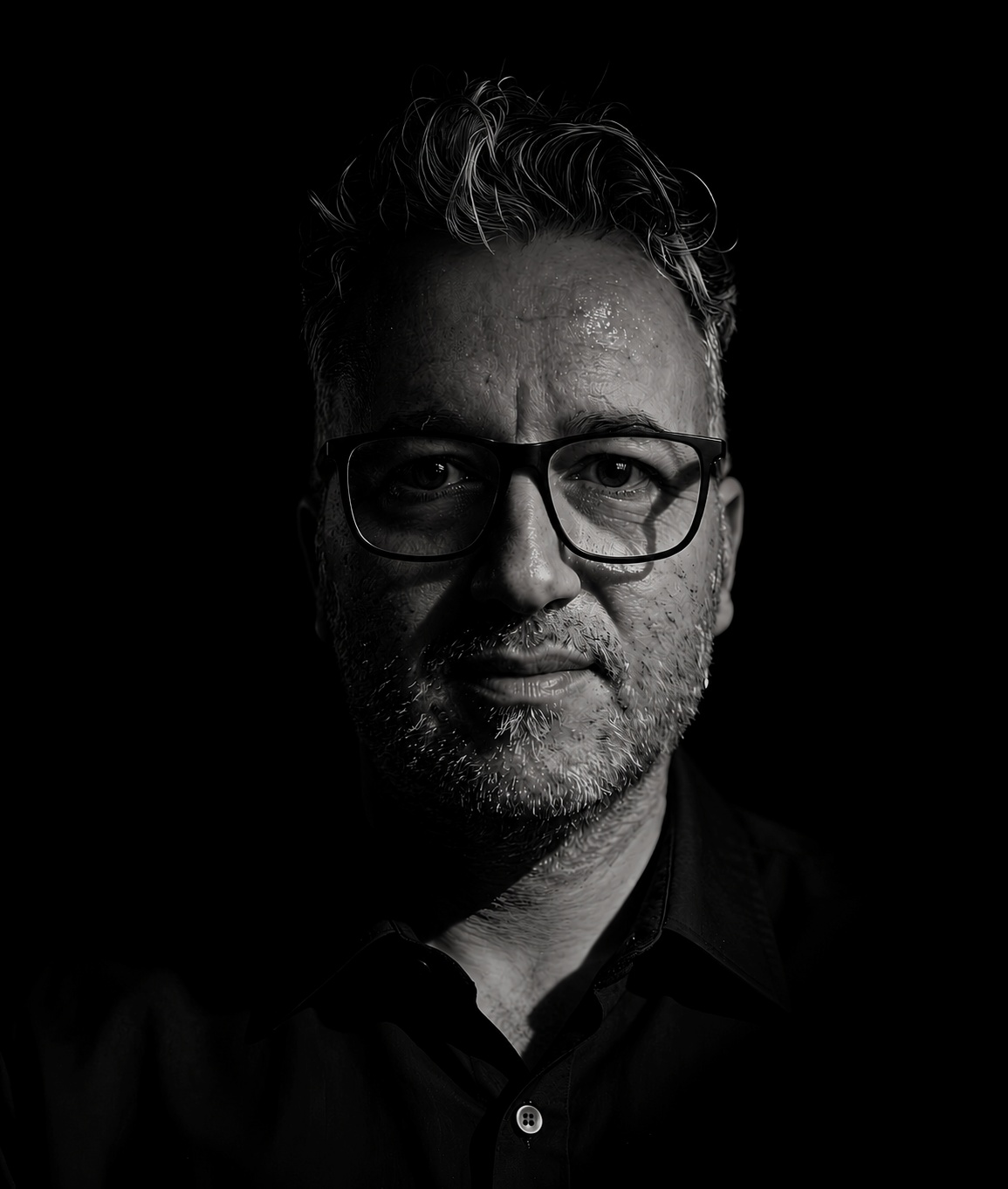
What drives you as an artist?
— I want to achieve something
that no one else can do.
How do you define your gift?
— I don't believe I have any special gift.
What I do have is great dedication,
strong discipline and a deep love
for what I do.
What makes your work unique?
— My work is unique because no one ever taught me how to do it.
It was born entirely in my own mind.
Over the years, I have shaped and refined it
into what it is today,
and I am now very proud of the final result.
What do you seek when someone commissions a work?
— I seek to create an emotion
that lasts forever.
Vision and Expression
Many artists talk about the relationship between light and art. Since glass interacts directly with light, how important is lighting when you imagine your pieces?
— Each piece needs its own light.
Portraits illuminate themselves, so they should be displayed with very soft lighting so that the portrait stands out more. However, images of animals require more light to enhance them and allow you to play with the shadows.
When you begin a new work, do you start with a clear vision of the final piece, or does the process evolve organically as you work?
— Yes, before starting I already know how the piece will turn out.
First there is hard work in digitizing the image, playing with the tones and the size until I reach the final sketch.
Once I have the sketch, I show it to the client. If they approve it, I start working, which takes about a month per piece.
Your work includes mosaics, paintings and murals. How do you decide which format best expresses the idea you want to communicate?
— I only dedicate myself to making mosaics. I don't make paintings or murals. I'm not capable of making a picture with paints; I don't have that gift.
My gift is taking an image and turning it into a work full of patience, dedicating many, many hours to it until the final result is perfect and unmatched.
The Emotional and Cultural Dimension
Mosaic traditions have existed for centuries across different cultures. Do you see your work as part of that historical continuum?
— It's clear that my technique is much more advanced than the mosaics that were made before, but it's true that the way of making them is the same: placing thousands of pieces completely by hand (without machine assistance), with skill and above all with a lot of patience.
What emotions or ideas do you hope viewers feel when encountering one of your glass works for the first time?
— This is one of the most rewarding parts for an artist, at least for me.
I pay a lot of attention to the reaction the client has when they see their portrait for the first time. That reaction is the judgment of all the effort and dedication I had to put into completing the piece. And believe me, when the client or people who see my works for the first time (it may sound bad for me to say it, but it's true) they are amazed because they are completely different.
In what ways does your cultural background influence the stories or themes in your works?
— It depends on the work. For example, I'm from Elche and I have made several different works of the Lady of Elche. Since it's an icon of my city, it has meant a different emotional value compared to a portrait of a person I don't know.
Art and Human Connection
When someone stands in front of your work, what kind of emotional or intellectual experience do you hope they leave with?
— What matters here is that they know how to appreciate the effort involved in making a work like this, so different and with so many hours of work. That they appreciate it and value it like any piece of art.
A special commission: the portrait of a woman who has passed away. There was a very special portrait you created for a client: the portrait of a woman who had passed away, so her husband could have an image of her at home. How did you approach an artwork of such emotional significance?
— With a lot of respect. First I wanted to do the sketch very carefully to bring back the memory of that person as beautifully as possible. Then I worked with even more patience and dedication than usual, knowing that it was going to be a very special work.
What was the most meaningful reaction you received after he saw the finished piece?
— When he saw the finished portrait he started to cry… He told me that now he could look at his wife every day and still feel her close to him. That was a very rewarding and emotional moment for me.
Artistic Vision and Legacy
What do you hope someone feels when living with one of your works?
— I don't expect admiration.
I hope they stop for a moment.
That they discover something new every day.
Light changes.
The crystals change.
The work changes with them.
If a piece continues to reveal something years later, then it has fulfilled its purpose.
What does success mean to you?
— Success is not measured by the number of works sold.
It is measured by knowing that every piece left the studio exactly as I imagined it.
If I remain faithful to my standards, success will arrive on its own.
Light and Memory
Why crystals?
— Because light never lies.
Paint reflects colour.
Crystal reflects life.
Every movement of the observer creates a different work.
That is something only light can achieve.
One sentence that defines Yago Sánchez.
— I don't create portraits.
I build memories with light.
The Greatest Reward
“Every portrait begins with a face.
Mine begins with a story.”